Simon Wiesenthal
The Disappearance of Josef MengeleSimon Wiesenthal was a Holocaust survivor, investigator of Nazi crimes, and influential public advocate whose pursuit of Josef Mengele became inseparable from the stories he told about the hunt. The book presents him both as a persistent campaigner for justice and as a gifted storyteller who amplified uncertain leads into dramatic accounts. That tension matters: his work kept a fugitive’s crimes in public view, but his accounts also helped create the almost supernatural image of Mengele as a man who could escape any pursuer.
Background and public persona
Wiesenthal’s family came from Galicia and was murdered during the Holocaust; he was its lone survivor. After the war, he began gathering information about Nazi war criminals, first in Linz and later in Vienna, where he founded the Jewish Documentation Centre. His work was not confined to identifying fugitives. He campaigned against the prospect that West Germany would impose a statute of limitations, arguing in effect that the passage of time should not close the possibility of pursuing those responsible for Nazi crimes.
His public reputation grew after the publication of his autobiography, I Hunted Eichmann. The book says that Wiesenthal presented himself as having played a more decisive role in Adolf Eichmann’s capture than he had in fact played. The groundwork of Fritz Bauer remained little known, while Mossad agents were bound by strict confidentiality. In that gap, Wiesenthal came to personify the solitary Nazi hunter: a resourceful, accessible figure whose persistence could be understood by a broad audience even when the concealed work of prosecutors and intelligence services could not.
That public identity had a distinctive visual setting. Wiesenthal received death threats at his Viennese office, where a map of Nazi concentration camps hung on the wall. He wore tweed jackets and spoke English and German with a Yiddish accent. The book describes him as both a survivor of a vanished Central and Eastern European Jewish world and a skilled media performer, able to make the pursuit of war criminals visible to people far beyond the institutions conducting it.
The pursuit of Josef Mengele
After Eichmann had been tried and executed, Wiesenthal devoted much of his energy to locating Mengele. The search was difficult: his network was failing, and he had little reliable knowledge of where the doctor had taken refuge. He nevertheless worked to sustain public attention, insisting through his campaigning that Mengele must not be allowed to feel safe. His role combined investigation with advocacy, but the two did not always rest on the same evidentiary footing.
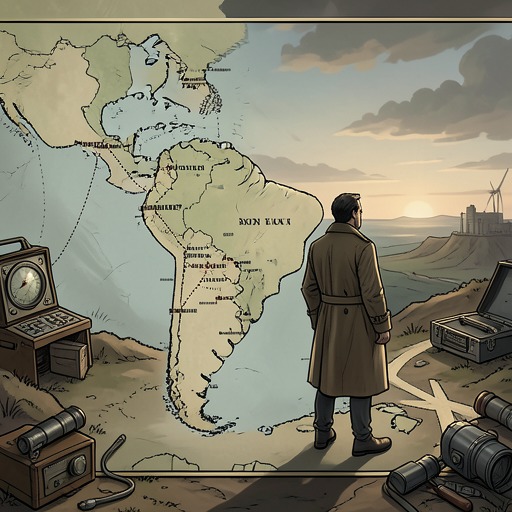
In July 1967, Wiesenthal published The Murderers Among Us, dedicating a chapter to Mengele under the title The Man Who Collected Blue Eyes. The chapter cast Mengele as a fugitive who could appear across South America and beyond: in Peru, Chile, Brazil, remote Paraguayan military camps, and the best restaurants of Asunción. It described him as wealthy, protected, and mobile, sometimes travelling with bodyguards and driving a black Mercedes. It also recounted an alleged attempt to enter Egypt, after which Mengele and Martha supposedly left by yacht for the Greek island of Kythnos. The book’s account made movement itself seem like Mengele’s defining protection: each reported sighting opened another possible route of escape.
Some of Wiesenthal’s most compelling episodes were also among the least dependable. He took the story of a Mossad agent killed in Bariloche and elaborated it into an account of a blonde spy who, he claimed, had been sterilized at Auschwitz by Mengele, recognized by him years later, and killed during a mountain excursion. The book treats this as an example of his embellishment, not as established evidence about Mengele. The episode shows how the figure of the fugitive could absorb stories that were difficult to verify, while the underlying demand that his crimes not be forgotten remained urgent.
Stories, evidence, and uncertainty
Wiesenthal’s account of a planned raid by Auschwitz survivors, the Committee of Twelve, at the Hotel Tirol in Encarnación likewise made Mengele seem almost uncapturable. In his version, the group arrived at night to seize him, only to find his room empty; he had supposedly been warned by telephone and fled shortly beforehand. The narrative turned an uncertain pursuit into a scene of narrow escape. The book’s framing requires a distinction between Wiesenthal’s account and facts independently established by the evidence it presents: his storytelling was influential, but vividness did not itself confirm a sighting or a successful escape.
At the end of the chapter, Wiesenthal disclosed what he presented as Mengele’s location in 1967: a small white hut in a militarized area between Puerto San Vincente and Fortress Carlos Antonio López, near the Paraná River. His description included German immigrant settlement, two guarded roads, Paraguayan soldiers and police, and four armed bodyguards paid by Mengele. The revelation gave the chapter the shape of a delayed answer, after a succession of reported sightings and escapes. Yet the account’s precision should not be confused with certainty: elsewhere the book emphasizes how little Wiesenthal’s network actually knew about Mengele’s whereabouts.
Public pressure and survivor testimony
Wiesenthal’s influence also operated through institutions and public campaigns. In 1985, survivors of Mengele’s experiments—including twins, dwarves, and people with disabilities—called for justice during commemorations marking the fortieth anniversary of Auschwitz’s liberation. At a mock trial held at Yad Vashem in Jerusalem, Wiesenthal sat on the tribunal alongside the chief prosecutor from the Jerusalem trial of Adolf Eichmann and the chief United States military counsel from the Nuremberg war-crimes trial. Survivors testified over three days. Their accounts described Mengele’s treatment of prisoners and families in the camp, making testimony—not rumor about his latest location—the centre of the proceedings.
The mock trial’s international broadcast helped provoke renewed demands for action. Before it concluded, the United States attorney general called for the complete file to be reviewed and for Mengele’s arrest. The Simon Wiesenthal Center added a million dollars to the rewards being offered for his capture, alongside a million-dollar reward from the United States and one million marks from Germany. These developments belonged to a broader coordinated effort; they should not be mistaken for Wiesenthal personally controlling the investigation. They did, however, reflect the public pressure that survivor testimony and advocacy could generate.
Significance and limits
The book’s account of Wiesenthal resists a simple choice between hero and fabricator. He tirelessly pursued Nazi war criminals, pressed West Germany not to close cases through a statute of limitations, and helped keep Mengele’s crimes before an international audience. At the same time, his claims about his role in Eichmann’s capture and his elaborations of the Mengele hunt show how a compelling public persona could blur the line between what was known and what made a story persuasive.
That distinction becomes especially important when Wiesenthal later rejected the report that Mengele’s remains had been found in Brazil. By then, he had heard of the fugitive’s supposed death seven times, in locations ranging from the Russian front to Paraguay, Brazil, Bolivia, and Portugal. His skepticism was understandable in light of years of false reports, but the episode also captures the consequences of a pursuit shaped by both genuine uncertainty and accumulated legend. Wiesenthal’s enduring significance lies in that unresolved conjunction: he helped make the demand for justice impossible to ignore, while his own storytelling contributed to the mythology surrounding the man he sought.